
BMag Signal · In 30 seconds
Critical readWhat happened. Pirelli, the renowned tire company, is pioneering the world of pneumatic tires with the creation of a new type of rubber called 'cyber tyre'. This innovative technology is based on a series of innovations that could lead to a total transformation of cars.
A bright future awaits the future of automobiles with the 'cyber tyre' of Pirelli boasting a weight of just 13 grams, a weight that is exceptionally light for a tyre. It can detect aquaplaning, the floating of a car on a wet road surface, and withstands acceleration forces up to 4,000 Gs: this is equivalent to nine times the acceleration of gravity on Earth. These characteristics make this tyre incredibly reliable and safe, but it is not the only innovation Pirelli is developing. In addition, the 'cyber tyre' of Pirelli is capable of communicating with the assistance systems (ADAS) of modern vehicles. For example, it can control ABS, EBD, traction control, and so on, just for the sake of an example.
This communication system between rubber and software allows for improved active security of vehicles. The 'cyber tyre' by Pirelli does not just improve security. In a not-so-distant future, intelligent tires will become capable sentinels that can monitor road conditions such as potholes, ice, traffic, etc. This system aims to prevent potential accidents and improve risk management. Pirelli speaks not only of smart roads but also of the future of tires, which has changed over the past 20 years.
The connection between the car and the road is what makes the rubber capable of reading, leading to the closure of the circle towards the transformation from car to software-defined vehicle. In essence, the four wheels become part of a larger digital ecosystem. Not coincidentally, adds Corrado Rocca, head of the cyber unit at Pirelli, 'the role of software in modern vehicles has surpassed that of mechanics. In this context, our technology plays a fundamental role in supporting with new and reliable data the advanced functions of today's cars that are increasingly hungry for information.'
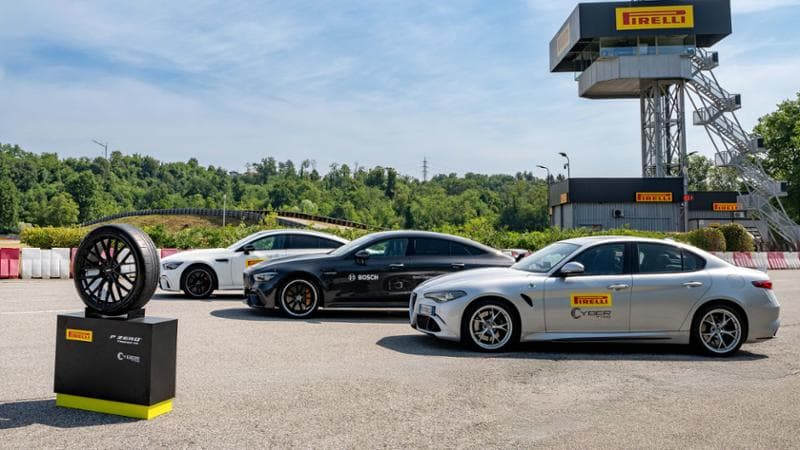
For the first tests, high-performance machines such as those used by McLaren, Pagani, and Aston Martin were employed. At the Pirelli testing ground, there are brands and models aimed at larger market volumes through collaborations with European, American, and Asian automotive companies. To achieve a more accurate and predictive understanding of the car's behavior, the company has entered into an agreement with RIDEsense, a spin-off from the University of Naples Federico II.
At the heart of the agreement lies the concept of sensor fusion: the algorithms of the cyber tyre, linked to the physical sensor of the pneumatic tire, work in tandem with the virtual sensors of RIDEsense, which use mathematical models to process already present data, estimating complex parameters such as residual adhesion or the state of wear on the brake pads. The challenge is not to collect more data, but to make it even more reliable. The 'cyber tyre' of Pirelli is based on an innovative approach that combines the precision of the data with safety, making it possible to have a more complete and predictive view of the car's behavior. This system aims to prevent potential accidents and improve risk management. In conclusion, the 'cyber tyre' of Pirelli is changing how we think about mobility.
Not only can it improve the security of cars, but it could also be the key to completely transforming future cars. This new type of rubber promises to take mobility technology to new levels of precision and reliability, making cars increasingly intelligent and efficient.
The news that matters, every morning.
Ricevi una selezione ragionata di business, mercati e innovazione.