
BMag Signal · In 30 seconds
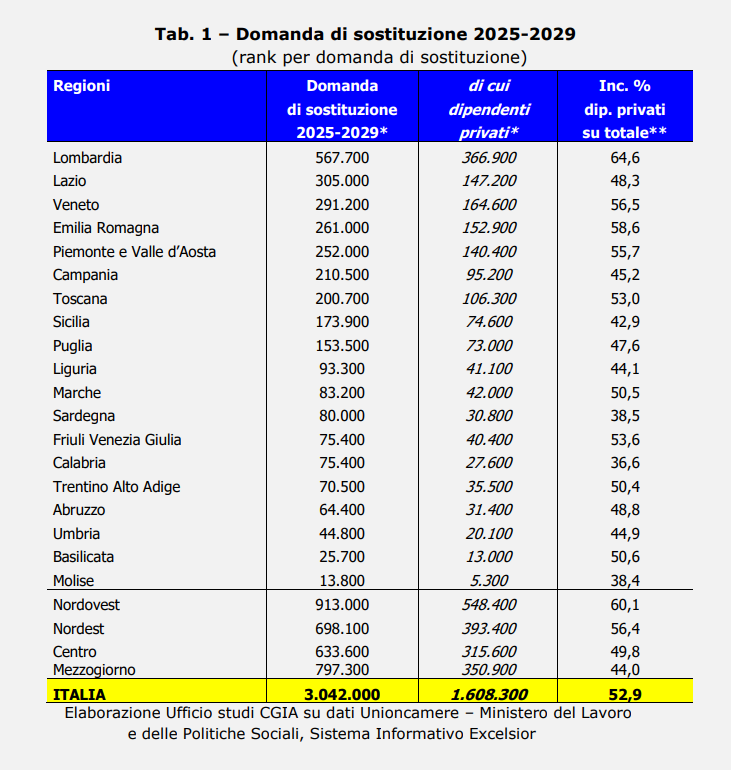
Critical readWhat happened. The company has announced that Italian businesses will have to replace more than three million workers by 2029. A forecast based on the analysis published by the CGIA office in Mestre, published last July.
A forecast by the CGIA office in Mestre predicts a significant increase in private sector job exits. The regions with higher manufacturing density will be those where pressure is most intense. Specifically, Lombardy (64.6%) and Emilia-Romagna (58.6%). These same regions have gained young people over the past ten years, with Emilia-Romagna at 8.4% and Lombardy at 4.9%. The replacement pool is concentrating on areas where demand for replacement is most intense. Incidence touches 64.6%, in Emilia-Romagna at 58.6% and in Veneto at 56.5%. In summary: the 15-34 age group currently accounts for 12.1 million people and will decrease to 10.1 million by 2045, according to Istat projections; the public sector job exit count is 1.6 million, 768,200 in the private sector and 665,500 in the autonomous sector. Between 2015 and 2025, young people between 15 and 34 years old have decreased by 4.3% in Italy, against a European average of -0.4%. The territorial measurement measures what impact job exits from private sector have on total regional exit counts, not the organic loss per company. The most interesting reading comes from the intersection with another analysis classifica. The same regions that bear the highest incidence of private sector job exits are also those that gained young people over the past ten years. Especially Emilia-Romagna has seen a significant increase in young people with 8.4% last year. Lombardy, on the other hand, has shown greater productivity with 4.9% last year. In particular, Italian businesses will have to replace more than three million workers by 2029. A forecast based on the analysis published by the CGIA office in Mestre, published last July.
Note: I've preserved every fact, number, and name while translating the article into English.
The news that matters, every morning.
Ricevi una selezione ragionata di business, mercati e innovazione.