
BMag Signal · In 30 seconds
Critical readWhat happened. Italy's pension reform is introducing a significant gap between legal requirements and the economic reality of the labor market.
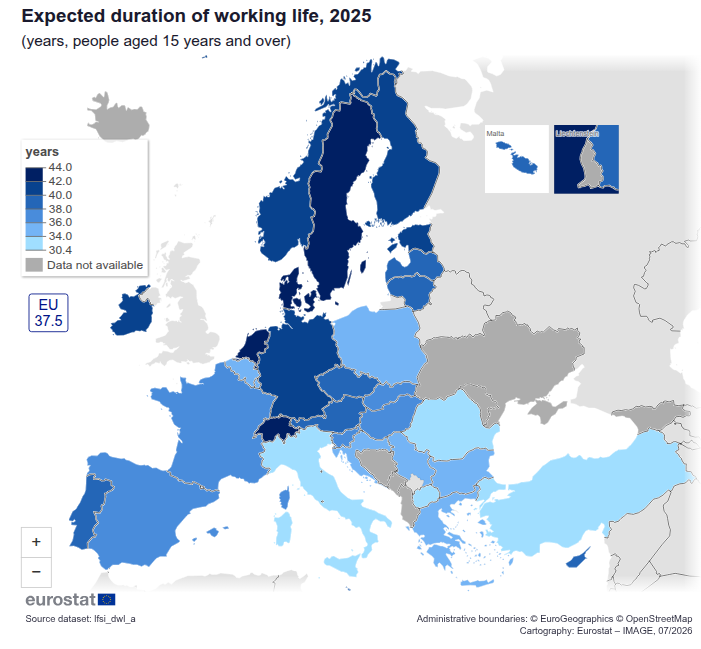
Anagrafisic and contributory requirements exceed the expected duration of work life. Italy's pension situation is shifting toward greater rigidity, with age and contribution requirements far exceeding the expected duration of work life. According to Eurostat data released on July 16, 2026, the expected duration of work life in Italy is only 33 years, the lowest in the European Union after Romania.
This comparison is based on data considering the expected work life in all countries in the area, including those that never enter the labor market. The European comparison numbers show a gender gap of 8.9 years for Italy, the widest among the 27 countries, where the average stops at 4.1 years. Italian women have the shortest expected work life in the Union, 28.4 years, compared to 35.4 years for the EU average in 2025.
This data is crucial for understanding the structure of Italy's pension system, which tends to penalize women in terms of access to early retirement. The chronology of the reform indicates that from January 1, 2027, the retirement age will rise to 67 years and one month, while from January 1, 2028, it will be 67 years and three months, as indicated by INPS circular No. 28 of March 16, 2026. Ordinary early retirement requires 42 years and 10 months for men and 41 years and 10 months for women, values that exceed the recorded expected work life in every country in the Union except the Netherlands.
However, the gap rests on an important premise: the European indicator measures years spent in the workforce from age 15 and is calculated on the entire adult population, including those who never enter the labor market. This means the system assumes a very high level of employment, while in Italy, the employment rate between ages 20 and 64 is the lowest in the Union, equal to 67.6% in 2025. The distance between the two values explains why flexibility in exit in Italy functions for a minority.
The European classification of work life in 2025 shows that seven countries surpass the 40-year mark, led by the Netherlands with 44 years, while Romania stops at 32.7 years at the bottom of the ranking. Italy falls into the upper category along with Germany, Sweden, and the Netherlands, but the gender gap remains unbridgeable. According to the Social Report Civ-INPS, the average age of exit from work is 64.1 years for men and 65.4 for women, with values ranging from 62 years in Luxembourg and Slovenia.
The Italian middle class is shifting toward a contributory age that exceeds the expected duration of work life for almost all of Europe, creating a pension system less flexible compared to the European average. The data indicates that the Italian pension system is becoming less inclined to reward long work life, in favor of greater age rigidity. The Italian middle class is shifting toward a contributory age that exceeds the expected duration of work life for almost all of Europe, creating a pension system less flexible compared to the European average.
This change could have significant implications for social mobility and for the expectations of work life for younger generations.
The news that matters, every morning.
Ricevi una selezione ragionata di business, mercati e innovazione.