

BMag Signal · In 30 seconds
Critical readWhat happened. A university team has won the world championship of autonomous driving without human operators inside their vehicle.
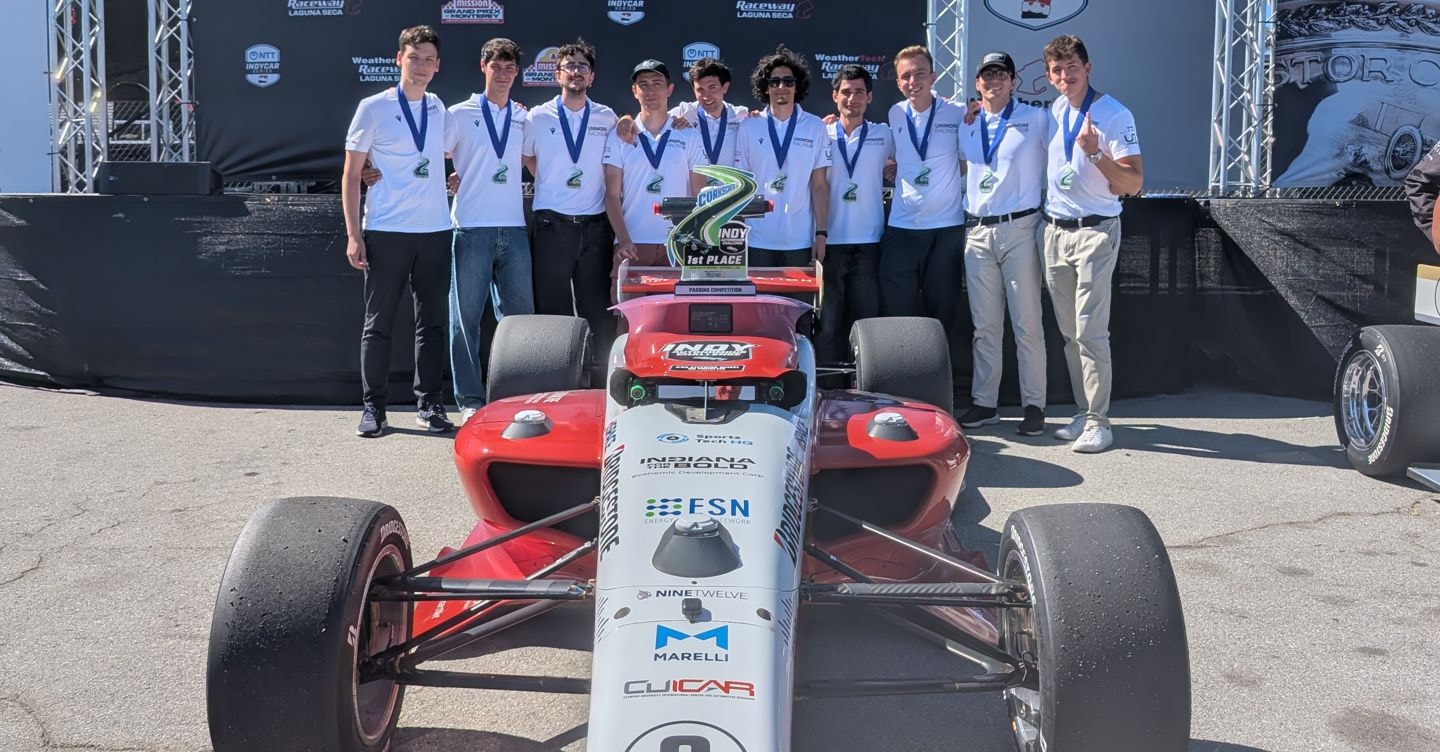
Modena and Reggio Emilia have triumphed in the Purdue vs. Italy duel at Laguna Seca, where speed rules supreme. The University of Modena and Reggio Emilia has secured the Indy autonomous challenge title by defeating Purdue's final round finale, marking an historic moment for Italian technology. Three overtakings on the Corkscrew, no pilot in the cockpit, allowed the Italian squad to dominate the head-to-head race. A driverless monoposto driven by students and researchers from the university:
"The digital pilot capable of reading the track, choosing the trajectory, launching attacks." It did this three times exactly at the Corkscrew, the sequence of curves that Legend Alex Zanardi built at Laguna Seca, which now bears his name 30 years after "Pass," 1996. The victory came at the end of the race, demonstrating algorithmic approach superiority over traditional manual guidance. In California they faced eight universities' teams besides Unimore and Purdue: AI Racing Tech, Auburn University, Caltech, and Politecnico di Milano. Second place was also achieved by another Italian reality, closing third with a national second position confirming the weight of Motor Valley and research in automotive industry. The hardware is identical; AV-24 starts its Dallara chassis derived from Indy Nxt adapted to driving without pilots. On board work radar, cameras, positioning systems, high-performance computers reconstruct what happens around the vehicle. Sensors recreate what goes around the vehicle while software fuses data and decides real-time how to brake, accelerate, steer or pass ahead. Here lies the game's outcome: algorithms, prediction capabilities, rapid response speed beyond 200 km/hour. The AV-24 designed for speeds up to 190 mph, more than 300 km/h, making track an extreme proving ground for technologies destined even to ADAS and road autonomous vehicles. For Unimore it’s a success that comes from afar, led by professor Marko Bertogna who had already set a record at Modena Autodromo: 58.3 seconds per lap, one second less than the previous world record held by Lamborghini Huracán.
The news that matters, every morning.
Ricevi una selezione ragionata di business, mercati e innovazione.
